
UK Trading Allowance: Who Qualifies for £1,000?
Home / Post Detail
The UK Trading Allowance lets you earn up to £1,000 in gross income from self-employment, casual work, or side hustles each tax year without paying tax on it or telling HMRC — as long as you meet a few basic conditions.
If you sell on Vinted or Etsy, walk dogs at weekends, tutor, freelance, or do any kind of small-scale trading alongside a main job, this allowance could mean you never need to file a Self Assessment tax return for that income at all. But go a penny over £1,000, and different rules kick in — rules that trip up thousands of people every year.
This guide breaks down exactly what the Trading Allowance is, who can (and can’t) use it, when it beats claiming actual expenses, and how it interacts with Self Assessment, National Insurance, and HMRC’s newer digital reporting rules. Every example uses 2025/26 figures, with a clear note on the reporting threshold change coming in 2027/28.
What Is the Trading Allowance?
The Trading Allowance is a tax exemption introduced in April 2017 to simplify tax for people earning small, occasional amounts outside regular employment. It sits alongside a similar exemption for property income, known as the Property Allowance.
In plain terms: HMRC lets you treat the first £1,000 of gross trading income each tax year as if it doesn’t exist for tax purposes. You don’t deduct it from a bill — it simply removes that income from your tax calculation entirely, provided you qualify.
It typically covers income from:
- Self-employment as a sole trader
- Casual services — babysitting, gardening, dog walking, cleaning
- Selling goods you’ve made or bought to resell (e.g. on Etsy, eBay, Vinted)
- Hiring out personal equipment, such as power tools
- Freelance or gig work
- Creating online content (where it counts as trading, not employment)
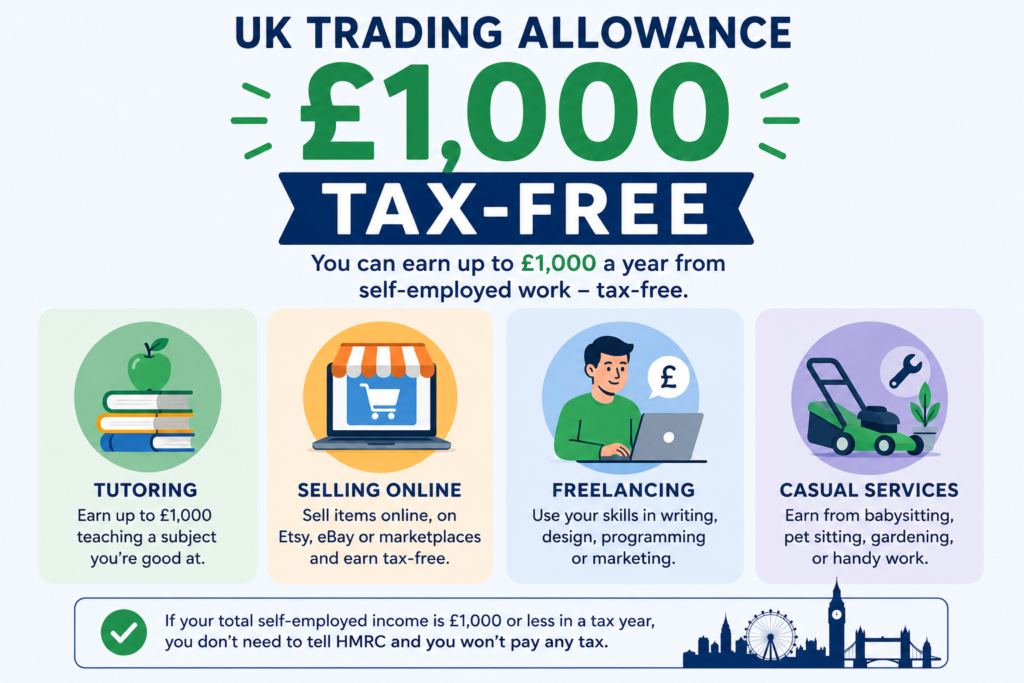
How Much Is the Trading Allowance in 2025/26 and 2026/27?
The Trading Allowance is £1,000 per tax year, and this figure has not changed since it was introduced in 2017. It remains £1,000 for both the 2025/26 and 2026/27 tax years.
A few important clarifications:
- It’s one allowance in total, not £1,000 per side hustle or per platform. If you sell on Etsy and do freelance graphic design, both incomes are added together against the same £1,000 limit.
- It applies to gross income, not profit. That means the full amount you receive before deducting any costs, materials, or fees.
- It’s separate from your Personal Allowance (£12,570 for most people in 2025/26), so the two can be used together if you also have a salary or pension.
- It’s separate from the Property Allowance, which is also £1,000 but applies specifically to income from land or property, such as renting out a driveway or garage.
Who Can Claim the Trading Allowance?
You can generally claim the Trading Allowance if you’re an individual (not a limited company or partnership) with gross trading, casual, or miscellaneous income, including:
- Sole traders
- Freelancers and contractors
- People with a side hustle alongside employment
- Students or retirees earning occasional income
- People testing out a new business idea
Who Cannot Claim the Trading Allowance?
According to HMRC’s official guidance, you cannot use the Trading Allowance in a tax year if any of your trading or miscellaneous income comes from:
- A company you, or someone connected to you, owns or controls
- A partnership where you or a connected person are a partner
- Your employer, or the employer of your spouse or civil partner
This last point catches people out often — if you do freelance or “side” work for your own employer (even something unrelated to your normal job), that income is excluded from the allowance entirely for that tax year, not just the portion from your employer.
It also does not apply:
- To limited companies (which pay Corporation Tax, not Income Tax)
- To income already taxed under PAYE as employment income
- To Rent a Room Scheme income (a different relief applies there)
- To trading income received through a partnership structure
Full Relief vs Partial Relief: How the Allowance Actually Works
HMRC splits the Trading Allowance into two scenarios:
Full Relief
If your total gross trading income for the tax year is £1,000 or less, the whole amount is covered by the allowance. In most cases, you don’t need to tell HMRC about it or file a return for that income at all.
Partial Relief
If your gross trading income is more than £1,000, you can still deduct the £1,000 allowance from your income instead of deducting your actual business expenses — but not both. This reduces your taxable profit by a flat £1,000, regardless of what you actually spent.
Feature | Full Relief | Partial Relief |
|---|---|---|
When it applies | Gross income ≤ £1,000 | Gross income > £1,000 |
Reporting to HMRC | Usually not required | Registration and Self Assessment required |
Tax owed | None | Tax due on income above £1,000 |
Records needed | Yes, still recommended | Yes, required |
Trading Allowance vs Claiming Actual Expenses: Which Is Better?
Once your income exceeds £1,000, you face a choice on your Self Assessment return: claim the flat £1,000 Trading Allowance, or deduct your actual allowable business expenses. You cannot do both.
Use the Trading Allowance when:
- Your genuine business expenses are less than £1,000
- You want simpler bookkeeping with minimal record-keeping burden
- You’re testing a new venture and costs are low
Use actual expenses when:
- Your allowable costs (materials, travel, subscriptions, home office costs, platform fees) exceed £1,000
- You want to claim capital allowances on equipment
- You need to record a trading loss to carry forward or offset elsewhere
Scenario | Trading Allowance | Actual Expenses | Better Option |
|---|---|---|---|
Income £1,800, expenses £200 | Profit = £800 | Profit = £1,600 | Trading Allowance |
Income £2,200, expenses £1,300 | Profit = £1,200 | Profit = £900 | Actual Expenses |
Income £1,000, expenses £50 | Profit = £0 | Profit = £950 | Trading Allowance |
Important: Choosing the allowance means you give up the ability to claim any expenses for that activity in that tax year — there’s no mixing and matching within the same trade.
Do You Still Need to Register with HMRC?
This depends entirely on your income level and circumstances:
- Income £1,000 or less, and you meet the eligibility conditions: You generally do not need to register for Self Assessment or file a return for that income.
- Income above £1,000: You must register for Self Assessment by 5 October following the end of the tax year in which you went over the threshold. For example, if you exceed £1,000 during 2025/26 (6 April 2025 – 5 April 2026), you must register by 5 October 2026.
- Even under £1,000, you may still need to register or file if:
- You want to pay voluntary Class 2 National Insurance to protect your State Pension or qualify for benefits like Maternity Allowance
- You want to claim a trading loss
- You have other income that already requires a tax return
- HMRC has already asked you to file one
You should also keep basic records of your income even if you never need to report it — HMRC can request evidence during a compliance check, and platforms like eBay, Vinted, Etsy, and Airbnb are legally required to share seller income data with HMRC under international reporting rules that took effect from January 2024.
How the Allowance Affects Your Self Assessment Return
If you’re already registered for Self Assessment (perhaps because of other income), you can still apply the Trading Allowance on your return instead of expenses. On the self-employment pages (SA103S or SA103F), you simply enter your income and select the allowance instead of itemising costs.
Bear in mind:
- You cannot create or increase a loss using the Trading Allowance — if your income is less than £1,000, the allowance only reduces your taxable profit to zero, not below it.
- Class 4 National Insurance may apply on profits above the relevant threshold (£12,570 for 2025/26) once you’re trading at a larger scale.
- If you claim the allowance, this affects certain means-tested benefit calculations, such as Universal Credit, differently than if you’d claimed expenses — so it’s worth checking how this interacts with any benefits you receive.
- The allowance does not affect Student Loan repayment calculations if the income is fully relieved by the allowance and your only other income is employment-based.
Worked Examples
Example 1: Full Relief — No Reporting Needed
Amir sells handmade candles online in his spare time and hires out gardening tools occasionally. His total gross income across both activities in 2025/26 is £820.
- Total trading income: £820
- Since this is under £1,000, full relief applies
- Result: No tax owed, no need to register or file a return, though he keeps basic records just in case.
Example 2: Partial Relief Using the Allowance
Priya works full-time in an office but tutors maths at weekends, earning £1,600 in 2025/26. Her costs (materials, travel) come to just £150.
- Income: £1,600
- Trading Allowance claimed: £1,000
- Taxable profit: £1,600 − £1,000 = £600
- Since her expenses (£150) are lower than the allowance, using the Trading Allowance is clearly better than claiming expenses (which would leave £1,450 taxable).
Example 3: When Expenses Beat the Allowance
Jordan sells refurbished electronics on eBay, earning £3,200 in 2025/26, with £1,800 in genuine costs (parts, postage, platform fees).
- Using the Trading Allowance: £3,200 − £1,000 = £2,200 taxable
- Using actual expenses: £3,200 − £1,800 = £1,400 taxable
- Result: Claiming actual expenses saves more tax — an £800 lower taxable profit.
Example 4: Employer Exclusion
Sam works for a marketing agency and also does freelance social media work for the same employer outside office hours, earning £900 extra.
- Because this income comes from Sam’s employer, the Trading Allowance cannot be used against it, regardless of the amount.
- Result: Sam must report this income and pay tax on it in full (subject to any actual expenses claimed), even though it’s under £1,000.
Recent HMRC Update: The 2027/28 Reporting Threshold Change
In March 2025, HMRC confirmed a significant change to reporting requirements — not the allowance itself. From the 2027/28 tax year, the Self Assessment reporting threshold for trading income is set to rise from £1,000 to £3,000.
What this means in practice:
- The £1,000 Trading Allowance stays exactly the same — you still only get £1,000 tax-free.
- But if your gross trading income is between £1,000 and £3,000 from 2027/28 onwards, you will no longer need to file a full Self Assessment return. Instead, HMRC plans to introduce a simplified online service to declare and pay any tax owed on income above £1,000.
- This is intended to reduce paperwork for an estimated hundreds of thousands of casual sellers, gig workers, and side-hustlers, while data-sharing rules mean HMRC still has visibility of platform-based income even without a full return.
This change has not yet taken effect and applies from the 2027/28 tax year onward. For 2025/26 and 2026/27, the existing £1,000 registration threshold still applies. Always check GOV.UK for the latest confirmed implementation date, as details of the simplified service have not been fully finalised at the time of writing.
Frequently Asked Questions
Q1: What is the Trading Allowance in simple terms?
It’s a £1,000 tax-free allowance for gross income from self-employment, casual work, or side hustles, letting many small earners avoid tax and reporting obligations entirely.
Q2: Is the Trading Allowance the same as the Personal Allowance?
No. The Personal Allowance (£12,570 for most people in 2025/26) applies to your overall income, including employment. The Trading Allowance is a separate £1,000 exemption specifically for trading and casual income, and the two can be used together.
Q3: Can I claim the Trading Allowance and expenses in the same year?
No — for a single trade, you must choose either the flat £1,000 allowance or your actual allowable expenses, not both.
Q4: Do I need to register as self-employed if I earn under £1,000?
Usually not, provided you meet the eligibility rules and your income qualifies for full relief. However, you may still choose to register voluntarily for National Insurance or benefit-related reasons.
Q5: Does the £1,000 apply per job or in total?
In total. All your trading, casual, and miscellaneous income across every source is added together against the single £1,000 limit.
Q6: What happens if I go over £1,000?
You must register for Self Assessment by 5 October following the end of that tax year, and you’ll need to choose between deducting the £1,000 allowance or your actual expenses when calculating taxable profit.
Q7: Can I use the Trading Allowance if I also have a full-time job?
Yes, as long as the trading income itself isn’t from your own employer or their connected businesses.
Q8: Does selling personal possessions count towards the Trading Allowance?
Usually not, if you’re simply clearing out unwanted items you already owned rather than buying or making things to resell. However, if items sell for more than £6,000 each, separate Capital Gains Tax rules may apply.
Q9: Will the £1,000 Trading Allowance increase in future?
There’s no confirmed increase to the £1,000 allowance itself. The change taking effect from 2027/28 raises the reporting threshold to £3,000, but the tax-free allowance stays at £1,000.
Q10: Do online marketplaces report my sales to HMRC?
heading
Yes. Since January 2024, digital platforms such as eBay, Vinted, Etsy, and Airbnb are required to collect and report seller income data to HMRC under international information-sharing rules.
Q11: Can I claim a loss using the Trading Allowance?
No. If your expenses exceed your income, you would need to use actual expenses (not the allowance) to record a loss, which may then be usable against other income or carried forward.
Q12: Is the Trading Allowance available if I only traded for part of the year?
Yes. You’re entitled to the full £1,000 allowance for the tax year even if you only started trading partway through it.
Conclusion
The Trading Allowance is one of the simplest and most valuable reliefs available to UK sole traders and side hustlers — but only if you understand its boundaries. It can save you from ever needing to register with HMRC for modest income, or reduce your tax bill through partial relief once you cross £1,000. The key is knowing whether the flat allowance or your actual expenses gives you the better outcome, and staying alert to exclusions like employer-related income.
With the reporting threshold set to rise to £3,000 from 2027/28, things are set to get simpler still for casual earners — but for now, the £1,000 threshold remains the figure that matters most.
Recent Blog


